I walked two miles today to see if some flower blossoms were still hanging from a bush. I crouched down to look up inside. They are like red umbrellas against a green background. I was curious if they were still there or had fallen, and I would have to wait until next season to meet them again.
These blossoms are one of many plant buddies I like to visit.
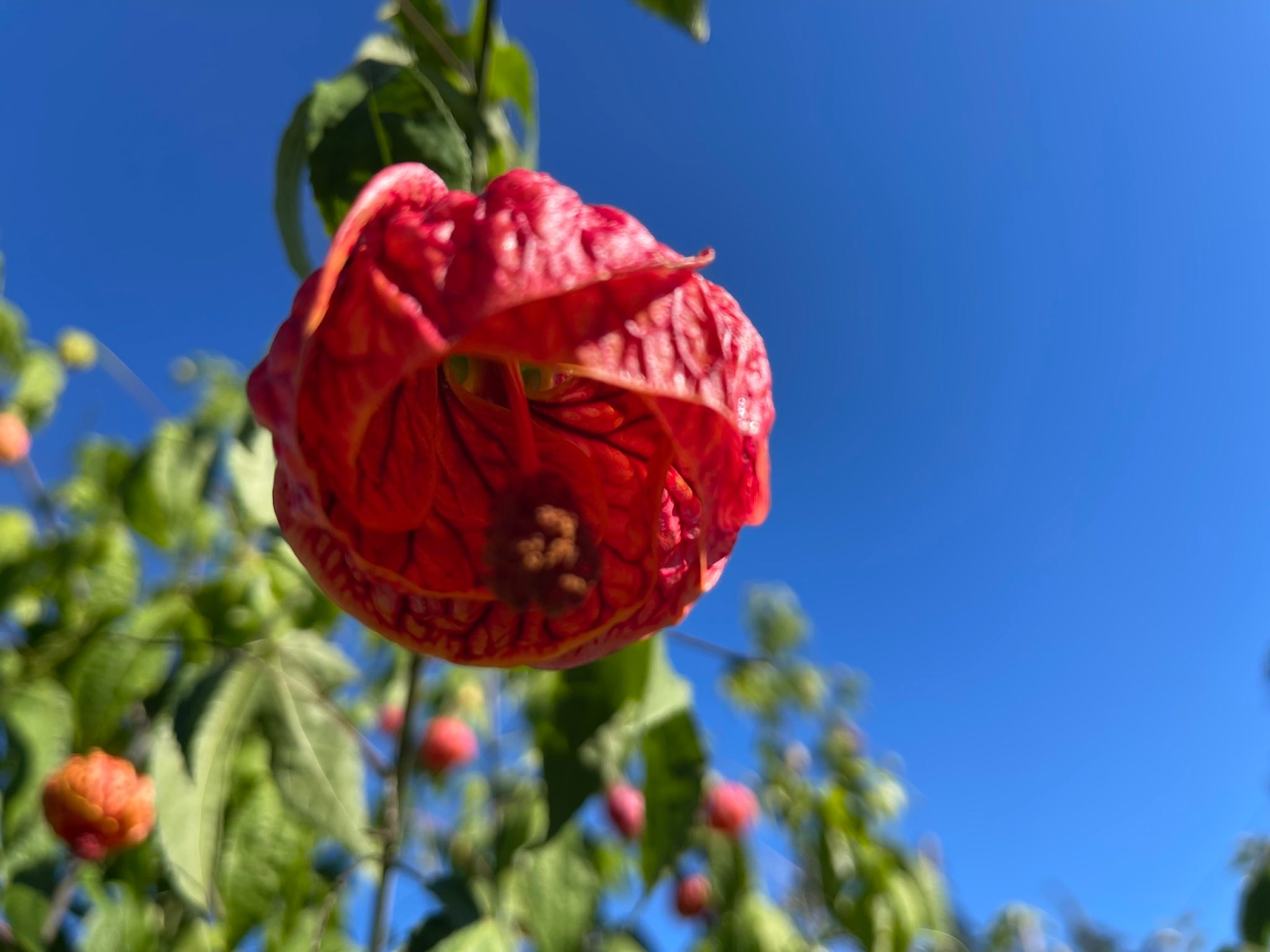
Photo by author
I am unlike my mother, who could recite the botanical name of nearly any plant she ran across. She was not a botanist or a gardener but had still learned their names. Do we still see the actual thing once we have put a name to it?
I have given nicknames to several trees near my home. Dragon Tree greets me with the knot of his wakeful eye, lichen underbelly, and moss and fern back. Has Dragon Tree given me, his frequent visitor, a nickname? Once, when I visited, a tiny mushroom was growing on his back. She was smaller than my pinky finger. I came every day and even convinced my grown daughter to visit. One day, small tears were in the mushroom’s back, and I knew the mushroom would soon be gone. I came home crying the day she disappeared. We would never meet again.
Mushrooms are the fruit bodies of vast mycelium root networks. The red flowers began life in underground roots. Do my plant buddies have minds? I wonder about the consciousness of my plant buddies. How do their senses differ from mine?
Mycelium networks commonly spread over several acres and can be hundreds of years old.
Groves of aspen trees are not a collection of individual trees just living in proximity. They are a community. They communicate and share water and information through a complex underground root system.
Pando, the aspen colony in Colorado, might be the oldest living being on Earth at 80,000 years old.
Archaeologist Christopher Henshilwood made a discovery on his grandfather’s land—a geometric design drawn in a cave overlooking the Indian Ocean 77,000 thousand years ago. This drawing in the Blombos Cave in South Africa is sixty thousand years older than the famous Lascaux cave drawings.
Drawing on a cave wall is a very human thing to do. What did this ancient person see looking out from this cave on a limestone cliff? Who were his long-ago plant buddies? What if this person could have seen Pando across the ocean, and today, Pando could have shared about their long-ago cave buddy?
Crying in response to the little mushroom reminds me of crying in the back of a red VW bus my mom is driving. I am seven years old. She had driven me to visit a friend, and the person who greeted me at the door said the family had moved. The felt sense of that cry from fifty years ago is like this recent one. The fact that I can hold them both, feel and compare them is mysterious. I have other crying experiences, but this is for a lost friendship.
We sleep and dream at night. Where do we go when our consciousness dissolves? How and from where does consciousness return after we awake? Do my plant buddies sleep and dream? Buddhists call the background of the mind storehouse consciousness. Psychologist Carl Jung calls it the unconscious. Modern physicists call it dark matter.
Our minds are much more mysterious and complex than they seem, the tips of a vast iceberg.
We cannot directly observe the unconscious; otherwise, it would be conscious. If we only had consciousness, there would be a ceaseless stream of disconnected experiences without any narrative structure to connect them. We are a story we tell ourselves based on a reservoir of experience we accumulate through life. What stories do plants tell and share?
If our consciousness and dreams sink into and grow in our unconscious, does our unconscious also dream and sink into a deeper unconscious? Jung called this the collective unconscious. Is this only the domain of humans, or do we share this shadow realm with animals and plants?

Photo by author
I stepped off the main trail on one walk to escape the rain. This new trail descends into a ravine. Growing in the trail were two tiny mushrooms together—memories of the Dragon Tree. I push a stick into the mud and lean a leaf against it to get a photo. I show the photo to my daughter, and she says, “It’s you and grandmother.”
Out walking and visiting my buddies I will find myself asking them questions. I listen to the questions they ask me. My ears do not hear words they speak but some part of me listens.
Note: Thanks to Shirley Rivera for editing and the emoji responses to my voice chat messages. Thanks to my other editors Rahul Sanghi and Samantha Law for letting me know what resonated and should be cut.
I also want to thank Raksha Joshi and Jade Barclay for their honest responses to my initial three ideas. (They bombed.) Jenny Herald, thank you for listening to my second try at pitching an idea. Thanks to Christin Chong for listening to my voice chat messages and taking an impromptu call.

 Epic Ken Rice