We are breathing all the time. So why would we need to meet our breath?
Just as we can have a shared history with a partner and yet fall out of intimacy; we can fall out of a relationship with our breath. We always have an opportunity to become reacquainted with our breath. We can become friends with our breath.
Breathing grounds us in our bodies, provides an opportunity for awareness, and connects us with the natural world all around us.
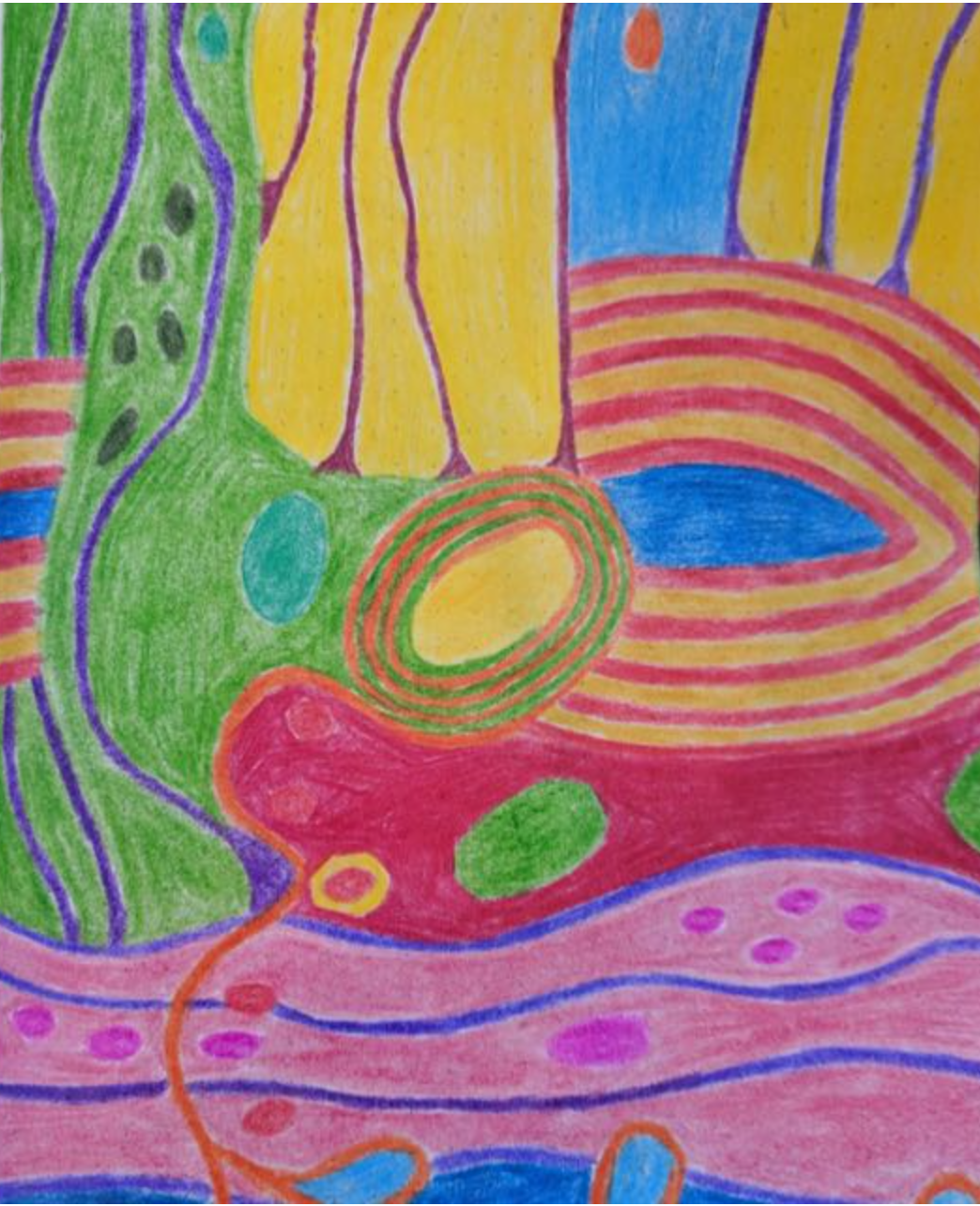
Artwork by author following a breathwork session
“Breath is the bridge which connects life to consciousness, which unites your body to your thoughts.” – Thich Nhat Hanh
Directing attention to the breath allows us to slow down and become fuller. Our breath and our nervous system are connected. Slowing down and fuller breaths create a space to rest and relax. Feel the quality of your aliveness.
There are many breath techniques. They can be used to help recover from physical illness, improve concentration, let go of trapped emotions, reduce anxiety, release negative thought loops and beliefs, and even find your voice.
The following practice is an invitation, a single step on a path of discovery.
Practice
You can practice sitting or lying down. You may like to have a glass of water to drink either during the practice or afterward. Finally have a journal or even a piece of paper to write on after the practice completes.
Integration
Reflect on your experience and write down any insights that may have occurred. If nothing seems to have happened during the practice, that’s fine.
Integrating an experience is an organic process. Trust that your body knows what to do. Any benefit of the practice will naturally emerge. You may feel called to make meaning or look for coherence in that which arises naturally out of the process. Trust your intuition and your senses to provide you with a beautiful gift.
“The syntactical nature of reality, the real secret of magic, is that the world is made of words. And if you know the words that the world is made of, you can make of it whatever you wish.” – Terence McKenna
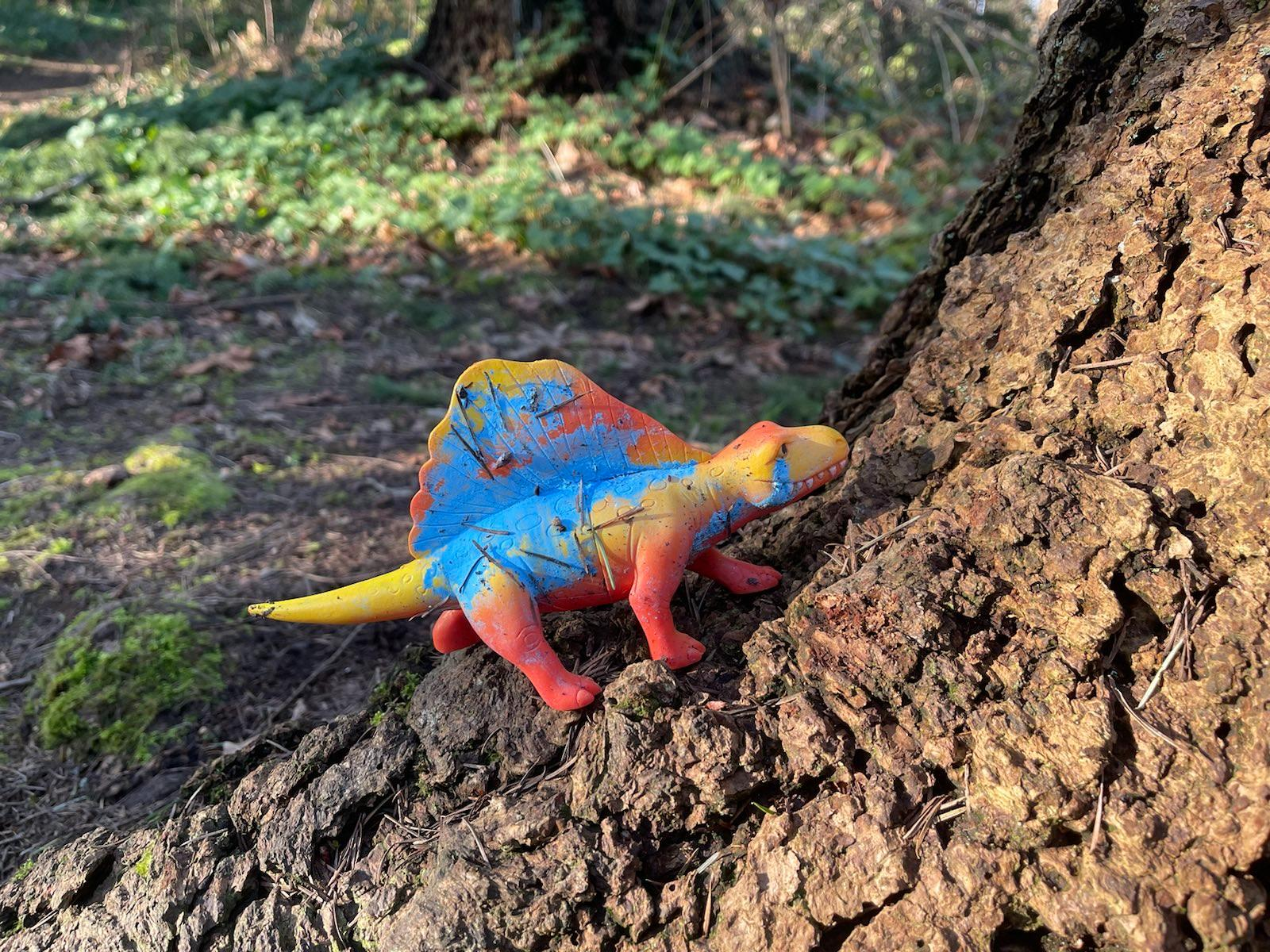
I walk daily on a group of trails. Evergreen pine trees, ferns and moss greet me most days. Yesterday there was a colorful dinosaur climbing a tree. I have no idea how the dinosaur got there, presumably it was left by a child playing. I wonder what the child was imagining as they played. My childhood — a distant memory, a blurry color-washed polaroid photo. Barely surfacing is an image of myself playing with a small plastic dinosaur.
During a conversation with fellow writing group member Chris Wong, I said that maybe we are hallucinating all the time because our brain naturally produces a chemical called DMT, short for dimethyltryptamine, that is structurally related to LSD. This led to Chris challenging me to write an essay considering the question: Is reality a simulation? Taken aback and my curiosity piqued, not only would I consider this question, I already began to process my reality. In my mind’s eye I reviewed my life, the movies that explore this idea, and my reading in diverse areas.
Before the walk when I met the plastic dinosaur, I was in a group call with an older Lakota Sioux woman who began a meeting talking about her morning.
“First of all I want to tell you how my day started because it was an unusual magical day. And I think it is a precursor to us meeting. I woke up this morning to solid snow, thick snow falling. In about a half hour the sun came out and it continued to snow, and the clouds moved away, and the sky was bright blue, and it continued to snow. And it snowed for twenty minutes with the sun out. So I think it’s a miracle. And even if it isn’t a miracle it’s absolutely gorgeous, and it’s unusual, and it can be done. If anyone told you it snowed for twenty minutes without any clouds would you believe them until you saw it?”
Later in the meeting she said, “We are not here by accident.”
Our lives have meaning. Being alive is a miracle. I believe that each of us is here to walk a good, true, and beautiful path. And nobody can tell you what to believe. Instead let’s journey together. I will share some pivotal life experiences that have made me question the nature of reality.
Saving A Cat
“…the mirror is the imitation of life. What is interesting about a mirror is that it does not show yourself as you are; it shows you your own opposite.”– Douglas Sirk
Computers and virtual reality headsets have changed how we literally and figuratively perceive reality.
Computer adventure games – I love them. These games are a mixture of puzzle solving and immersion into an interactive story. I played a variety of these games. Playing text adventure games such as Zork where you type instructions such as “north” and “open door” immersed me in the world of the game’s creators. It was like reading those choose-your-own adventure books from the 1970’s where you made a choice and turned to a random page, instead of reading cover to cover. With games like Zork you ended up making a map on a piece of paper to denote your progress. Later I was amazed by the graphics of Myst. Wandering around on a seemingly abandoned island, solving puzzles and piecing together a mysterious story.
While living in Tokyo a friend and I went to a virtual reality exhibit at NTT’s Intercommunication Center. At one exhibit there was an actual steel beam on the ground and at the end of it was a stuffed cat covered in sensors. I put on a VR headset along with a pair of gloves that contained sensors. In the simulation I rode an elevator up to the 50th floor and then walked out on the steel beam to rescue a frightened meowing cat. I was sweating, short of breath and felt my muscles clenching as I made every attempt to not fall to my death. My fear of heights had kicked in and I failed to rescue the cat. The cat remained on the end of the beam plaintively meowing for rescue as I carefully backed up to the safety of the elevator. I then watched on a monitor my friend successfully rescue the now purring cat.
The use of physical objects to improve the simulation was fascinating. Also multiple live views of the same event. Watching my friend in real life walk out on the beam and pick up the stuffed cat while also watching what happened on a video monitor gave me the illusion I was voyeuristically seeing the world as my friend privately saw it. Close friend Shirley Rivera delighted me by reflecting, “SOMETHING i LOVE about this – which is like watching the reality of someone else’s virtual reality – in YOUR REALITY.”
The multiple views reminds me of a scene in the 1973 German science fiction film World On A Wire. Inside the mirror-filled Institute for Cybernetics and Futurology, the staff watch identity units on a bank of television screens, computer simulated people based on those who work at the Institute. The units are unaware they are just a simulation inside a generated world called Simulacron. The lead character and hero of the story, Fred Stiller, says the doppelganger identity units are “like people on TV dancing for us.” Stiller ends up entering Simulacron which in part leads him to realizing that we are all living in a simulation. One is able to exit the revealed simulation of this world and enter true reality, which in turn may also be a simulation, like nested Russian dolls.
The movie was originally shown as a two-part movie on German television as viewers watched this story about simulation from the reality of their homes.
Indistinguishable From Magic
“Any sufficiently advanced technology is indistinguishable from magic.”– Arthur C. Clarke
Psychologists have written books on how our environment can affect both our mood and our perspective.
I had a strange experience in a float tank — lying naked in warm water mixed with epsom salt so that my body floated. The lid on the tank was closed. The lights were off. I wore ear plugs. At one point I saw Egyptian looking hieroglyphs before my eyes. They were glowing with a green light like text on an old computer terminal. As I looked more closely at what I thought was a drawing, I realized it was lines made out of tiny ones and zeroes. Yes, binary. I thought of the protagonist, Neo, in the movie The Matrix as I reached to touch the drawings on the roof of the float tank. The drawing remained. Fascinating. I know it was not real but still it was happening. I believe our minds are hallucinating like this all the time, but we are so busy with our lives that we do not notice.
After a while the hieroglyphs went away. By so drastically removing visual and auditory stimuli, and allowing my body to relax with the floating, I was able to see a subconscious reflection of my thoughts. I am reminded of the phosphene patterns we see by closing our eyes and gently pressing on our eyelids.
BBC Horizon Clip of McGurk effect
In this McGurk Effect demonstration, you hear and see a person saying “ba.” The image of the speaker’s mouth is then changed and they appear to be saying “va.” If you close your eyes you correctly hear “ba” but if you open them you hear “va” even though you know the person is saying “ba.” This effect is created by manipulating video. It is fascinating how our sense of sight overrides our sense of hearing.
Perhaps based on our environment and mental state we are subtly manipulating reality, but being able to alter reality is not the same as reality being a simulation.
Recreating The Past
“Denial ain’t just a river in Egypt.”– Rap song
A reality simulation does not just recreate the matter of the physical world, time is also recreated. What is past, present, and future become interchangeable. Memory becomes a time travel video game.
False memories have led to people being found guilty of crimes they did not commit.
Classic. Ronald Cotton was wrongfully imprisoned for 11 years for the rape of Jennifer Thompson. During the rape Jennifer focused on remembering the face. When questioned by a police detective and shown a photo lineup she was sure she had identified the correct person. DNA evidence led to finding a different person. Ronald and Jennifer have since become friends and worked to change the laws around how police interrogations happen.
Dramatic. A woman Beth who was experiencing anxiety and received counseling from her church. Thru counseling they uncovered that she had been raped by her father and had two abortions, one that she had given herself using a coat hanger. A gynecological exam by a doctor revealed that Beth was a virgin.
My friend and fellow writer Laila Faisal mentioned that memories can be imprinted in our genes. Did Beth’s mother or grandmother experienced rape and abortion, and this was imprinted in Beth’s genes? The scientific term for this area of study is “transgenerational epigenetic inheritance.”
Cinematic. In the film Blade Runner, androids are implanted with false memories of childhoods. One android carried polaroid photos of a life they never lived. Zooming in on one photo there is an image of a child near a tree playing with a dinosaur. Rizwan Virk who authored the book The Simulation Hypothesis poses a question with a follow-up: “If our memories of the past can be modified, does this also mean the past can effectively be modified? Is there a meaningful distinction between these two?”
I am reminded of Joe Dispenza speaking about an emotional becoming a personality trait in the documentary The Science of Changing Your Mind.
“And if you do not know how to control your emotional reaction and you allow that emotion to linger for hours or days, you know what that is called? That’s called a mood. What’s wrong with you? Oh, I’m in a mood. Why are you in a mood? Well this thing happened to me six days ago and I am memorizing my emotional reaction. And now if you allow that emotional reaction to continue for weeks or months, that’s called a temperament. What’s wrong with him? Oh he just has an angry temperament. Why are you so angry? Well this thing happened to me nine months ago and I’m memorizing my emotional reaction. And now if we keep that same refractory period that’s connected to a past experience running for years on end that’s called a personality trait. So would you agree then, by very definition, people memorize emotions that are connected to their past that they begin to wear as their personality.”
I am struck by how not only can we have false memories – but also we can inherit memories and even practice memories until they become a defining part of our personality. The malleability of memory may make me question what is true. Yet, does this extend to reality being a simulation?
Humans are malleable.
The Baby Thing
“You have to take seriously the notion that understanding the universe is your responsibility, because the only understanding of the universe that will be useful to you is your own understanding.”– Terence McKenna
November 2019 I went to Prana Del Mar in Mexico for a week-long retreat with people I knew from a local yoga studio. It was lovely to feel such warm weather and to be right on the beach. One sunny late afternoon we gathered in a large room named the Sun Studio to practice conscious connected circular breathing. We placed our yoga mats and blankets in a large circle. Shades of woven fiber were let down at the windows but the sun still snuck into the room.
Lying down on the floor we covered ourselves with blankets. We inhaled actively and exhaled passively. Over and over like the turning of a water wheel. There was no pause at the end of the exhale or inhale. It was intense, short of hyperventilating. The facilitator began playing loud rhythmic music over the sound system and guiding our journey.
My mind was busy. I was working to pay attention to my exhale and inhale. And then suddenly “I was being breathed” as practitioners put it.
Sometimes one experiences an altered state of consciousness.
I sat up, looking around the room. With no shirt on, I was holding a baby. Surprise! I looked down at this baby in my arms. I felt the baby’s skin and warm body against my own. Amazing. I knew this was not real, and yet it was. To me, this was real. I could even smell the baby. Who is this baby? My son – I wondered? (Granted, my son was 25 years old at the time.) No! The baby is not my son. It dawned on me. I was holding my father. I was flooded with emotion. The rush of love. And forgiveness.
A week later I told my wife about this experience. She looked at me puzzled. We now jokingly call this my experience of the Baby Thing. I can tell the story without mentioning the baby at all. I can say I was circular breathing in Mexico and realized how much I love my father and forgave him for some childhood memories.
I hallucinated with all my sense that I was holding a baby while lying down on the ground. Oh yes. I never sat up or looked around the room. I was wearing a shirt the whole time. I imagined all of that.
This is what I remember.
Entering With Your Left Foot
“In this world, we walk on the roof of hell, gazing at flowers”– Kobayashi Issa
One of my teachers told a story of her teacher telling her to always enter the zendo, the meditation hall, with your left foot. Is the foot you enter a room with that important? No, it turns out. But paying attention is deceptively deep. Paying attention is important.
Rewind. Out walking in the woods, a plastic dinosaur left behind by a child causes me to reflect on my childhood, as if seeing an old photograph. An elder woman provides a beautiful reflection on the miracle of snow falling from a blue sky. An attempt to rescue a stuffed animal cat from a simulation which can simultaneously be viewed from a monitor leads into a reflection of a German television audience watching a movie about reality being a simulation which the actors are able to view via a bank of television monitors. An experience in a float tank with sensory deprivation led to reflecting on how our visual sense can override our hearing. Next up, a brief reflection on false memories and practicing memories. Finally the mind does not even need a stuffed cat to conjure up a baby in the present moment.
Life is a beautiful gift. This life is a beautiful gift. Our life is a beautiful gift. There are rational arguments for the simulation theory, but the wonder and love evoked by this gift makes my heart say, “We are not living in a simulation. Humans are malleable.”
When I looked into his eyes it was like meeting a friend you have had your entire life. There was a mixture of delight, mischief, and curiosity. He awoke these same qualities in me. “I will be your teacher and friend,” he told me as he looked into my eyes. This was the day I met a tanuki, a Japanese raccoon, on a beach after swimming across a dark sea.
Our meeting was a new experience. I lay on a yoga mat covered with a Mexican wool blanket in a Victorian living room on a former military base converted into a state park. I closed my eyes and listened to two people playing frame drums.
I entered a door in a tree trunk I saw when walking in my neighborhood and descended into the earth on a winding dirt path. I came to a cliff and dove into the sea, swam with the stars shining above me, and came up onto a beach. Walking ashore, I was determined to find my animal teacher as instructed. This first journey was a meet-and-greet where he became one of my shamanic guides.
Talking with an imaginary animal might seem unfamiliar, but it is part of an ancient practice that can support us with a new way to answer questions. The type of question should be important to you – Should I move? Should I take this new job? How can I deepen my commitment to this relationship? Before we start receiving answers to your questions you need to meet the teacher who will help you.
How Did You Get Into This?
A woman asks me in conversation, “How did you get into this?” The answer starts with living with my mother during the last months of her life. She told me several times to do whatever I wanted to in this life and not be concerned about others’ opinions.
Every morning while she was still asleep, I would do yoga at a nearby studio. I saw a flyer for a weekend workshop that combined yoga and shamanism. I wasn’t expecting an instructor who reminded me of a truck driver in her matter-of-fact approach to life.
A few weeks later, I did a second workshop where I made a drum and a rattle. I still remember being outside with a group of eight people on a warm summer day. I cut a piece of deer hide, stretching it over a round wooden frame.
I would share my experiences with my Mom. I saw her excitement as I learned new things. She would smile and nod. Sometimes we would talk for only 10 minutes, and then she would nap; other times we spoke for 2 hours. We both loved watching the moon in the sky together at night and the deer that would gather outside to nibble on the green bushes during the day. Shortly before my Mom died, she told me, "Be brave like me."
What Are Helping Spirits?
Shamanism is a study of the earth’s wisdom and a way to tap into the unseen powers of the natural world. Shamans have been doing this for thousands of years. One thing commonly found across all shamanic cultures is the understanding that the natural world is alive. Behind the forms of the natural world are unseen powers that can be understood and even directed to help human affairs. You often hear the term helping spirits, the enlivened and unseen aspects of the natural world. These helping spirits often take the forms of nature and meet the shaman in the altered state of awareness generated by the shamanic journey.
You are invited to do the journey yourself. The teacher who comes forward through the journey is meeting you exactly where you need to be met. The journey becomes a path of self-understanding and self-transformation.
The Role of the Drum
The journey will be taken listening to a drum. The repetitive sound helps you alter your awareness. We tend to live our lives in a fairly straightforward, rational, problem-solving state of awareness. Our conscious mind is good at helping us filter out non-essential aspects of our experience. The journey requires an expansion of consciousness, awareness, and the ability to step into a different way of knowing. We all do this every night when we dream. As we move into the dream state, our awareness shifts, and we have a different experience of ourselves and reality. The journey allows for a more directed way to access this altered state rather than waiting to dream.
A Three-Part World
Shamanism often describes a three-part world that is like the natural world around us. We have the upper world of the sky, the middle world of the earth’s surface, and the lower world below the surface. Shamans from many cultures report that only compassionate beings are found in the upper and lower worlds. The middle world has both compassionate beings and those that are not. A bit of practice and study is needed to enter into the middle world safely and without fear.
Finding Your Teacher
Lying down and listening to the drum, you will be closing your eyes. Choosing to cover your eyes may help you look inward more. The journey usually takes about 10 to 15 minutes. You will want to have your journal and pen. You may want to record your journey if you say something during it. Make sure you are in a place where you can lie down and not be disturbed. For this first journey you will travel into the lower world to meet a teacher in animal form.
I am going down to the lower world to meet my teacher in animal form. I can enter through a hole in the ground, a hole in a tree, a cavern, or a body of water. This is not an imaginary place or a place from my dreams. I can walk, swim, fly or fall. I may move through some kind of transition or simply stop going down. I may find myself in a forest, in a desert, in the snow, or in a place I have never imagined. I may move through the lower world or stay in one place. I will keep my attention focused and ask my teacher to present itself. I may hear, see, or feel the presence of my teacher. When I become aware of an animal, I ask, “Are you my teacher in animal form?” I will pay attention to the animal for an answer. I may receive a verbal message, a telepathic message, or simply have a knowing. I will stay with my teacher learning until it is time to return. If the answer is no, I will simply look around for another animal to meet. When I hear the callback, a change in the drumming rhythm, I will turn around and come back exactly how I came.
When the music finishes, you should be back in the room where you started. As you come back, let yourself get oriented. Review your journey. And when you are ready, go ahead and write down your journey in as much detail as you can. Then take some time for reflection.
Asking My Question
You will return to the lower world for your second journey and ask your animal teacher a question. You will journey there the same way you did the first time and return when you hear the callback.
I am back on the beach with the tanuki and ask, “What practice can you offer me for when I feel overwhelmingly lonely?” Suddenly the beach and my teacher are gone. I am inside the lobby of a movie theater with multiple films showing. Looking down, I notice the hypnotic red and black pattern of the carpet. Looking up, I see no staff and feel I cannot walk in and watch any of the films. I reach into my pockets and feel no money or ticket. I have been here for a thousand years. Why is this nightmare happening? I thought I was alone before, but now I am alone. My forehead is dripping with sweat as I shake in fear. I do not know what to do.
There is no solution and no one to ask for help. I feel unable to speak but manage to whisper a feeble call for help. Suddenly I am inside a room with people, and there is a film showing. Tanuki is sitting next to me. He grins and then winks. Suddenly we are in a different room. We continue to teleport between rooms several times. Next a tree starts growing inside the theatre. No one seems to notice the tree except for the tanuki and me. The tree is large and continues to grow, branches sprouting and writhing with leaves. Hearing the callback, I returned to the room where I started.
Asking Your Question
The question you ask on this journey is a question of importance to you. It is on any subject, in any arena, and any level of experience. The critical thing to remember when generating the question is that it should not begin with “why” since why questions are challenging to answer. You want to have a question that starts with what or how, or where. The reason for this is because the answer needs to be understood in the context of the question. So when you’ve asked a simple one-part question, you’ll know that everything that happens in the journey and with your guide pertains to the question. When you have your question, write it down, so you don’t forget it. You don’t know what your teacher will do to answer your question. Stay close to the question paying attention to everything that the guide does.
Interpreting The Answer
How do you interpret the answer you received to your question? The journey helps you build an inner trust, learn to trust guidance, and receive knowledge from your own ways of knowing. Learning the language of the journey can take time and is not dissimilar to the language of dreams. As you learn to interpret the images, ask what they mean to you. Ask where you may have been exposed to the image before. Does the image remind you of something? Have I experienced this before? Spend time trying to understand your emotional experience and your emotional reactions in the journey. Spend time with the images, the emotions, and looking at the journey symbolically like you would a dream. The language of the journey and dreams is primarily one of images and symbols. With practice you will be able to trust your inner knowing more fully.
With my journey, I realized I am prone to indecision and can become lost in my sense of loneliness. There is a hypnotic quality, and it feels endless. All I need to do is to join with others. They are not avoiding me. We can share in everyday experiences represented by the films. On a deeper level we are all connected. I needed the gift of seeing that connection made clear with the tree growing before my eyes. That connection is both alive and needs to be nurtured.
What’s Next and Resources
You can take other journeys to the lower world. Next you can learn to journey to the upper world and then the middle world. Some parts of the journey may not be clear, or you may feel the process is not working at all, or you may even feel you are only making this up. Keep practicing. Be brave and seek answers to those questions that are important to you.
Shamanic drumming music is readily available from the Internet. Some possible sources are Sandra Ingerman, Michael Harner, and my favorite, “Sacred Drums for the Shamanic Journey” from sacredstream.org.
I never thought much about the question “How are you doing?” until Covid started. My family went into extreme isolation. None of us left the house except for walks in our neighborhood, and we had all of our groceries delivered. My father-in-law passed, and my wife went to be with her mother, who has dementia. She has been gone for six months now. Our twenty-year-old cat died. My computer died, and I lost essential memories not backed up. My phone died, and I lost some lovely chat histories. I am not sure why my response to this series of tragedies was not sadness. Rather, I responded with depression.
Swallowed up by nothingness, I lost track of who I was. Isolated and alone, there was no one to whom I could explain my situation. I tried to hide what was going on because I did not want the stigma of mental illness. My depression worsened, and then even that concern diminished. I had no idea how to change my lot. Intellectually I knew many self-care practices, but that did not lead to any action. Shipwrecked in my psyche, waves of sadness and futility battered me. In many ways, my inner realm mirrored the outer world’s tragedies. Maybe I had removed a final filter and was seeing the world as it is.
Was this a perverse kind of enlightenment? Or was I drunk where the hangover and recovery never came, constantly inebriated by nightmares and dread? No escape because I cannot stop being myself.
Conditions with Covid improved, and I started shopping again. Old friends from out of town visited. I drove out of town and took ferry rides for several extended weekends of spirit work training – house blessings and shamanic soul retrieval. I also took part in a traditional vision quest ceremony. My mental health slowly improved, but at first, I wasn’t sure. I came out of my depression after an evening drum circle at a friend’s house in the countryside. Before Covid, I gathered regularly in communities that sang—yoga kirtan, healing ceremonies, and drum circles. I had lost the sense of being alive, and then, as the poet Jane Kenyon writes, “… and suddenly, I fall into my life again.”
The evening in the country starts with strangers being introduced and eating a potluck dinner—my plate has chili casserole, pasties (a savory baked pastry), and fruit cobbler. The sun goes down and seven of us are sitting in folding chairs in the backyard around a fire. Above us, the stars are out, and the moon is almost full. Each of us has a frame drum and a beater except for one man with chronic finger pain. He is holding a rattle. We drum and sing and talk, sharing songs and stories for the next four hours.
One woman in a tie-dyed t-shirt wearing a straw hat shares about her partner passing and how she spent years being angry at others and herself. She talks about the Anishinabe, a First Nations people who live around the Great Lakes, and sings their Strong Woman Song for us. The song allowed many indigenous women to survive solitary confinement in a prison where they were abused for being native peoples. After the song, we talk about the recent mass graves found at now-closed schools for native children in Canada. School officials murdered children as young as three years old. In the evening’s darkness and for times of great challenge in our lives, we have this song as a gift.
Another woman wearing a long dress and a black vest jacket is a single mother raising two high school boys. They are becoming increasingly independent. She shares a Lakota Sioux song about two brothers who are each on a side of a canyon. They sing to each other to let the other know they are ok. She shares about being at a vision quest at Standing Rock Indian Reservation where a young man who fasted before the quest ended up dying. The vision quest is not an easy experience, but while you are alone on the land you are held by your community. She talks about her work at the local church for the youth. I love witnessing this mother’s love for her children and those in her town.
My friend mentions I had recently completed a traditional vision quest. The woman in the black jacket asks to hear about it.
I share that an 80-year-old Lakota Sioux grandmother ran my quest. There is a nodding acknowledgment—four days in nature, alone without food and water. My only provisions are a sleeping bag, a wool blanket, and a tarp to wrap myself in if it rains. It rains. I fail to wrap myself correctly so end up soaking wet below the waist. The following day it is windy and overcast. I have no drum to beat on or journal to write in. All I have is my voice, so I sing and pray for my four days and four nights. There are twenty of us scattered in our isolated sit spots. Each sunset the support community gathers, drumming and singing five or sing songs for us. We reply with howls and cries of gratitude. In the middle of the night, you can hear another singing. We sing for each other and for those at home who are here with us in spirit.
I sing in front of the fire the song I sang I sang for my fellow questers.
Spiraling into the center, the center of the wheel
I am the weaver; I am the woven one
I am the dreamer; I am the dream
A third woman, whose partner is the man with the rattle, shares about her adult daughter who is schizophrenic, not taking her medication, and addicted to crack cocaine. She lives in a run-down trash-infested trailer on their property. Her diet, if she does eat, consists of soda and candy. There is so much heartbreaking despair here. Parents unable to save or even help their child. I reflect on raising two children with my wife. We faced many challenges but none approach this. We listen. No one offers advice or solutions. We hear and our listening becomes a song, affirming the importance of prayer for me.
I have a new reverence for family, friends, and community. Even when it felt as if I was unable to receive their love and concern, I was. The sun and the moon continue to rise and set. Song has always been important to me but now holds a more gentle and generous space in my heart.
There is an Albanian proverb that goes: “Show me your friends and I’ll show you your future.” That particular configuration of people in that drumming circle in that time and place will never repeat itself. Yes, we could all get together again but it would be a new gathering. The flow of life continues to move and transform. Grieving and celebrating with others heals us and perhaps, just maybe, allows us to survive a period of deep sadness or depression.
I returned to work in September 2019 after a one-month leave of absence for my mom’s death. I was still deep in grief but decided not to hide it. I would be working at my desk and let the tears stream down my face. I did not run off to a private room to sob. I was like this for three months. Word spread through the office, and thus began dozens of conversations about grief.
My co-workers opened up to me about their grief. I talk with a woman who also lost her mom. She is not ready to grieve. A man opens up to me about losing his brother to suicide, another woman about losing her cousin to suicide. I meet a woman at a potluck who tells me how both her parents’ death was beautiful, but the grief is still there when talking about her partner who passed 18 months ago. My heart opened from all these stories. I welcomed them. None of these conversations felt easy but we are no longer strangers when we share our grief.
I received a voice mail from my mom in May 2019. She told me to call her because she had something important to say to me, but to call after Jeopardy. I learned she had gall bladder cancer. She came to Seattle for a diagnosis, and the doctors said she had six years to live. After talking it over with my mom and brother, I moved in with her in Port Townsend. She passed three months later.
When I arrive, I become overwhelmed with sadness and do not want to cry in front of my mom. I drove to a local market to get some food. I ended up going right through a stop sign before I parked. As I walked into the market, a man sitting on a chair outside said, “What an asshole.” I did my shopping, and as I left, I looked over, and he was glaring at me. I sat down next to him and apologized. He did not believe me and told me how he had been rear-ended while riding his motorcycle and now suffered from PTSD. I looked right into his eyes and said, “My mom is dying.” He nodded his head and told me his father had passed ten years ago. He was still grieving. I sat there with him in silence, and we end up becoming friends.
I cleaned her home for those three months as she sat on the couch telling me about every item. Each item had a story. At times I reminded myself to record some of these conversations with my phone. I realized I soon might never hear her voice again. She would share a story about wearing a dress out to dinner or from when she taught Spanish in high school. With books, she would remember the New York Times review she had read or tell me all about an author’s life from Miguel de Unamuno to Wislawa Szymborska to Pablo Neruda.
Every July there is a week-long jazz festival in Port Townsend. My mom really wanted me to go hear her favorite jazz piano player George Cables. I usually go to bed early and he was playing at 10:00 pm. My mom looked at me and said, “Be brave like me.” So I went and met George and let him know about my mom who came to see him every year. “Be brave like me” has become a motto I live my life by.
A hospice care nurse visited weekly. My mom asked the nurse, “How will I know when I am close to dying.” The nurse replied that a standard indicator is darkened rings around the knees. My mom lifted her nightgown, peered at her knees, and innocently said, “Oh, not yet, I guess.” The nurse began crying while apologizing. My mom took her hand and said, “Look how the beautiful color of your ring matches the colors of your shirt.” She was so present in the moment.
My mother passed on the evening of August 10, 2019, during the time her favorite TV show Jeopardy was airing. She was 84 and missed her birthday in October. On her bedroom wall is a painting of a wooden boat on a rough sea. A vase of locally picked flowers is beneath it. Her final words two days before were, “I see the river.” My younger brother and I are by her side, each holding one of her hands as she takes her last breath. My brother and I look at each other and he says, “She’s gone.” Much later that evening after phone calls to relatives and her body being taken away my brother returns home and I go to sleep on the bed next to my mom’s empty bed.
Waking up I emailed work to take a leave of absence. Grief hit me hard. I felt like a wave at the beach had knocked me over. Surprise, bewilderment, and sadness all at once. Every unresolved problem in my life was suddenly in front of me holding a ticket saying “Me first.” I had no idea what I should be doing. The entire month was a blur. I spent most of the time outdoors at a beach listening to the waves or walking in the woods getting lost. There is the story of Lakshman, in the Indian epic the Ramayana, sitting beside a river preparing to die and reflecting on his life saying “It’s like something I dreamed once, long ago, far away.” Eventually, my grief faded like a dream.
This January, my Japanese father-in-law died at age 91 in Tokyo. His birthday was two weeks earlier. A week before his birthday was the anniversary of his mom’s death. He was able to place an offering of food for her on the Buddhist shrine in his home. My wife says her grief feels like she cannot breathe, like walking up a hill and not catching your breath. She tells me that just holding her hand helps. She asks me questions about how I felt when my mom passed.
Today I took my wife to the airport. She is going to Tokyo to be with her mom for six months. Grief is not something to avoid or quickly recover from. Just as the oak tree is already in the acorn, grief, like love, shapes who we are. I miss my mom and father-in-law. I miss each of the people whose story was shared.
In the later part of January I sat down with my neighbor Anat Ben-Shaul to discuss relationships and matchmaking. We have been neighbors for 4 years and say hello to each other in passing. Anat has had longer chats with my wife and daughter. My daughter told me about Anat’s blog. I really enjoyed the blog and this led me to ask her if she would sit down with me and chat.
Anat started with a blog A for LifeStyle writing on a variety of topics. Her posts on matchmaking were a hit. She ended up reaching out and interviewing matchmaking experts from many countries. This led to a second website Making A Match. The idea behind the site is wonderful. Usually on a dating site you write your own profile. This can lead to some surprises for both people going on the date. To alleviate the cognitive dissonance you have a trusted person write your profile. There are no photos. This trusted advocate meets first with those who are interested in your profile. Your advocate will establish an initial trust relationship with this potential partner.
Anat also hosts a free talk from various relationship experts at the Redmond Regional Library on the first Thursday of every month at 7 pm. Details about the event can be found on the Making a Match Facebook page.
Finally since I had heard the amazing story of meeting the family of a favorite author I asked Anat to talk about the novel Reflections: A Love Story by the South African author Eleanor Baker. It all started with a blog post.
In the later part of January I sat down at Ophelia’s Books in the Fremont district of Seattle to talk with Jill Levine about what it is like to run a book store and about creative pursuits. Jill has two degrees, the first in philosophy and the second in studio art, specifically sculpture. Her art is on view inside the store and I am very happy to have one of her “thinking cap” pieces incorporating Hegel on my desk at work. She has also been writing a novel.
In the beginning of January I spoke with my friend Dale Lloyd about music and listening. Dale is a musician and runs the music label and / OAR. We discuss phonography and field recordings of an environment. We discuss music soundtracks and how they work with the moving visual images.
During the conversation Dale brings up Japanese film Ozu Yasujirō’s “pillow shots.” Ginron on YouTube has made a short film of these shots set to a piece of Dale’s music.
At the beginning of January I spoke with my chiropractor Jason. Our conversation touches on healing and recovery. I also ask him why folks in obvious discomfort and pain do not seek support.
I firmly believe the human body is both amazing and perfect. Our body knows how to heal itself and to stay in balance with our environment. And not just our physical body. The same goes for our mind, heart and spirit. I know that sometimes in my journey I get out of alignment. This is when I seek support.
Last year training for my first triathlon, the Seafair Triathlon, I managed to injure myself swimming, bicycling and running. I ate a whole food plant based diet high in nutrient density and anti-inflammatories; along with fueling and hydrating during training. I did yoga daily (vinyasa, hatha and yin). I slept 8 to 10 hours every night. I started meditating. And yet my body was having discomfort all over.
I met Jason at a health fair where I work and got into a discussion with him. This led to me visiting his office many times over the last 6 months.
I sent Jason some written questions before our conversation and he typed up a response. He gets a bit more technical here than in our talk but it is a nice complement.
My written questions:
I came to see you because of discomfort I had from triathlon training and sitting in an office all day: neck pain from sitting at desk typing on a computer, lower back pain from cycling, hip and knee pain from running, and shoulder and rotator cuff pain from swimming. You supported me in recovering from all of them. But I also learned that recovery is not just reactive to injury but is also proactive. For example I learned movement exercises I can do to support me staying in a healthy injury-free physical state. How important do you think it is for someone to see a chiropractor even if they currently have no discomfort?
I had some stereotypical ideas of what a chiropractor does, mostly popping people’s backs and necks. I was surprised to discover this is a very small part of a typical session, like 1 percent. There is a lot of deep tissue and range of motion work, work done with distracting one muscle to work on another, and the movement and posture exercises. And of course there are all kinds of cool toys one can use to help too. How do you see your role in terms of the techniques and tools you use?
I have had friends who have an injury or discomfort and I will ask them what they are doing? Some mention having visited their family doctor but most are either hesitant to see a chiropractor or to see any professional to support their recovery. I see a parallel with not exercising and having poor nutrition. Why is it that as human beings we take such poor care of ourselves? How can we change this without being prescriptive or judgmental?
Jason’s written response:
This is a really good question and the answer is long an complicated. First of all I think it is important to identify that there are many types of chiropractors and different towards assessment and treatment. Many chiropractors focus on the spine and only the spine. Their whole approach towards care is identifying areas of the spine that are not moving correctly and manipulating or adjusting these joints with restricted movement in order to restore alignment, range of motion and neurological function. this type of care is important and can be very effective when indicated. Chiropractors with this approach toward care educate the nervous system that lives in and interacts intimately with the spine. For the most part I agree with the philosophy and more importantly the science that supports this approach toward assessment and treatment.
The other end of the chiropractic spectrum are practitioners that are basically a hybrid between a chiropractor and a physical therapist. On type of using their knowledge of the spine, they are also educated on biomechanics of the whole body and they pay close attention to different muscles, fascial chains connecting muscles, joints, tendons, ligaments, the lymphatic system, peripheral nerves and the neurological relationships between these things. As you can imagine, when the scope of practice expands to include all of this the practitioner is able to be a lot more effective in treating a lot more conditions and also more effective in a preventative capacity.
The later type of chiropractor, lets call them a Sports Chiropractor, works with active tissues, tissues with contractile properties that are connected to the nervous system and are responsible for determining your active and dynamic posture, as well as all of your movement patterns. When we approach treatment by effecting these tissues whether it be with manual therapy, soft tissue manipulation, joint mobilization, or exercise therapy, we are able to make changes to individual and full body joint mechanics and movement patterns.
The body is alive and programmable. The body adapts to imposed demand and we can essentially use imposed demand as therapy, coaxing the body into growing where it needs to grow and programming it to move, stand, or sit in optimal and healthy ways in order to be more efficient and powerful during functional activities as well as with normal everyday demands like prolonged sitting and standing.
So to get to answering your question. Most people have some kind of dysfunctional movement pattern, sitting or standing posture, strength-tension relationship in their muscles, neurological imbalance, or segmental spinal dysfunction. Any and all of these things can lead to early onset arthritis through repetitive joint stresses or an eventual ligament, tendon, intervertebral disk or muscle tea, tendinopathies and a variety of other inflammatory conditions caused by repetitive stress such as myositis or fasciitis.
Many of my patients will come in for a certain injury and we uncover other dysfunctional areas that they were not aware of or were just ignoring as the symptoms were not that bad. When we begin to address these things they feel so much better. They sleep better, they breathe better, the nagging low level pains go away, their freedom of movement improves and their performance improves. This encourages them to work out more often and harder, it encourages them to change lifestyle habits that are negatively impacting them and ultimately they are more healthy and happy.
So yes I think it is important to get help with your body. It doesn’t have to be a chiropractor. There are a lot of good practitioners out there, but I would emphasize the importance of getting help by someone who incorporates both soft tissue manipulation and exercise together in a treatment session. One without the other is still good, but together they work so well.
I had two conversations with my friend Nidhi in November and December last year. We spoke about poetry, writing, everyday magic and abundance. For the first conversation my friend Amelia Kwan joined us. Nidhi and I have worked together for 12 years. During that time Nidhi has done some amazing things. She now has two books published, one of poetry My Wedding With Truth and a second that is a mix of memoir and fiction A Journey to Yonder. A third book is in progress!
Here is the text of the wonderful poem Nidhi reads towards the end of our conversation:
For all my life, I have looked for blessings, not knowing that I am a blessing.
For all these years, I have wandered in search of truth, not knowing that I am the truth.
For all the time, I have waited for miracles to show up, not knowing that I am a miracle.
For every breath, I have longed for love, happiness, and peace, not knowing that I am all of these.
For all the prayers I have prayed asking the divine to show up, not knowing that I am the divine.
For all the time I wasted in the dark, I know now is the right time to shine my own light.
I loved the first poem Nidhi read in November and so asked for her to read another poem. Here it is:
i wait for words to be written on paper like drought stricken earth waits for a drop of rain
longing is the poison a lover must drink the coal craves in darkness till one day it itself becomes the light
this is what happens when patience sprouts from your burning a worthless being turns into a spectacular diamond
keep the ember alive put your desire on fire and wait earnestly



 Epic Ken Rice